





Reviews of CDs
* Worth hearing
** Recommended
*** Essential listening
CHRISTMAS CDs
***
NOËL
Armonico Consort / Emily Wenman (soprano) / Alexander Hume (tenor) / Edward Picton-Turberville (organ) / Christopher Monks ✦ Signum Classics SIGCD754
This attractive disc of Christmas music is beautifully and expertly sung by the Armonico Consort. There are familiar carols: The Shepherd’s Carol by Bob Chilcott, Darke’s In the bleak mid-winter, and Rutter’s Angels’ Carol and What sweeter music in addition to Victoria’s O magnum mysterium. These are interspersed with more unfamiliar works, including Toby Young’s The Astronomer’s Carol, Jonathan Dove’s The Star-Song and Jonathan Roberts’s Hope finds a way. The Armonico Consort were formed by a group of people with a passion for music from the Renaissance and Baroque, for which they are renowned. As well as the Victoria, we are treated to Jean Mouton’s Nesciens Mater. This is a wonderful collection of Christmas music, beautifully sung. Edward Picton-Turbervill’s sparkling organ accompaniments add another layer of delight to the recording – particularly in Dove’s The Star-Song and Rutter’s Angels’ Carol.

***
SWEET WAS THE SONG: CHRISTMAS MUSIC FROM TEWKESBURY ABBEY
Tewkesbury Abbey Schola Cantorum / Carleton Etherington (organ) / Simon Bell ✦ Regent REGCD577
This is a charming CD in which familiar carol arrangements – Ledger’s Sussex Carol, Vaughan Williams’s The truth sent from above and Rütti’s I wonder as I wander – sit alongside familiar texts with new tunes or arrangements, such as June Nixon’s The holly and the ivy and Stuart Nicholson’s Ding dong! merrily on high. Every year since 2006, the Dean Close Schools have commissioned a new Christmas carol for the Abbey choir. Nine are included here, including Alexander L’Estrange’s Isaiah’s Prophecy, Owain Park’s Lullay, my liking and Kerensa Briggs’s Sweet was the song the Virgin sang. The composers attracted to write for the choir, as well as the performances themselves, show the strength of the Tewkesbury choral set-up. Carleton Etherington provides sparkling accompaniments for Grayston Ives’s Susanni and Neil Cox’s Three are the precious gifts and organ solos in David Bednall’s beautifully meditative Wie schön leuchtet and George Baker’s rousing Toccata-Gigue on the Sussex Carol. A welcome addition to the Christmas collection.

**
SALISBURY CHRISTMAS
Choir of Salisbury Cathedral / John Challenger (organ) / David Halls ✦ Salisbury Cathedral
This recording of Christmas music both familiar and unfamiliar shows the choir of Salisbury Cathedral and its recently restored organ at the peak of their powers. Some of the tempi seem a little on the slow side, particularly God rest you merry, gentlemen, Gardner’s Tomorrow shall be my dancing day and Willcocks’s Sussex Carol, which lose a bit of momentum at a slower speed, yet there is much to admire in this recording. The a cappella singing of Sally Beamish’s beautiful In the stillness and Howells’s Sing lullaby is sublime. There’s also no doubting the beauty of the singing of Hadley’s I sing of a maiden and Rutter’s Candlelight Carol or the buoyancy of Errollyn Wallen’s Salisbury Carol. John Challenger’s organ wizardry in a Toccata on Wachet auf by David Halls himself, Bach’s In dulci jubilo (BWV 729) and Ireland’s The Holy Boy adds an additional dimension to the disc. Coming in at just under an hour’s music, one is left hoping for even more!

***
WINTER LIGHT: JOANNA FORBES L’ESTRANGE
London Voices / Grace Davidson, Imogen Parry (sopranos) / Guy Cutting (tenor) / Richard Gowers (organ) / Olivia Jageurs (harp) / Harry Baker (piano) / Ben Parry ✦ Signum Classics SIGCD873
This recording is a real family affair with music mostly for Advent, Christmas and winter by Joanna Forbes L’Estrange, with additional music by or arranged by her husband Alexander and son Harry. The first two thirds of the album tell the Christmas story from the anticipation of Christ’s birth and foretelling (Alexander L’Estrange’s jazzy and syncopated Isaiah’s Prophecy) to the birth of Christ and its significance for humankind (including Carol of the Crib, Song of the Shepherds – which incorporates quotes from several popular carols – and Love Came Down). The remaining third of the album takes in more secular pieces covering a wintery theme; however, A Present for the Future and The Three Wise Women do have religious themes at heart. The disc ends with an arrangement of Auld Lang Syne. The repertoire on this disc, brilliantly sung by London Voices, showcases the Forbes L’Estrange family’s skill as composers and arrangers. A must-have for an enjoyable listen, and inspiration for choral directors looking for new repertoire suggestions.

**
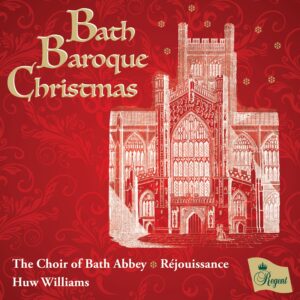
BATH BAROQUE CHRISTMAS: MUSIC FOR ADVENT AND CHRISTMAS
Choir of Bath Abbey / Réjouissance / Huw Williams ✦ Regent REGCD581
This is a delightful recording of some fine Baroque music for the season! The CD concludes with a fabulous performance of Charpentier’s Messe de minuit, before which come Praetorius’s Es ist ein Ros entsprungen, Quem pastores and Magnificat quinti toni, sitting alongside Purcell’s Rejoice in the Lord alway and O sing unto the Lord. All the works are sung with great spirit by the choir. Solos are also taken by choir members and sung, by and large, with precision, although one soloist has more vibrato than the others. Réjouissance provide sensitive accompaniments with Peter Wright (formerly of Southwark Cathedral) on the chamber organ. Overall, while some competing discs may have greater finesse, Huw Williams and his Bath forces provide a spirited and uplifting album of Baroque Christmas delights.
Ian Munro
CHORAL CDs
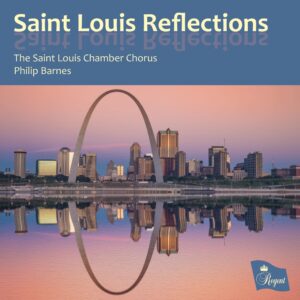
SAINT LOUIS REFLECTIONS
Saint Louis Chamber Chorus / Spencer Smith (organ) / Diana Umali (piano) / Philip Barnes ✦ Regent REGCD578
The Saint Louis Chamber Chorus, directed by Philip Barnes, has an admirable policy of commissioning new choral works and including a new piece in its repertoire every year. Here are 11 works, all commissioned by the choir and all receiving first recordings. Three of the choir’s successive composers-in-residence are represented, starting with Dobrinka Tabakova’s concise four-movement Missa brevis. Steven Stucky completed The music of light shortly before his death in 2016, setting a selection of lines from the Sufi mystic, Kabir, in Rabindranath Tagore’s translation. Listeners who know Magnus Williamson from his work on Tudor church music may be surprised by a different aspect of his output in Exaltabo. Kerensa Briggs’s name appeared in last June’s CMQ reviews as the choir’s current composer-in-residence; she contributes a Height in Depth suite, in which two psalm settings frame the poem by Christina Rossetti that provides the title. A Finnish poem inspired Charles Collins to write a sweetly charming Joulupuu on rakennettu (‘The Christmas tree is up’).
Better-known composers include Sasha Johnson Manning, who was the choir’s first composer-in-residence, Ivan Moody with an arrangement of Hildegard of Bingen’s O viridissima virga, and Judith Bingham, whose I lift up mine eyes unto the hills is accompanied by piano and organ: the only piece mentioned so far that is not a cappella. Carl Rütti’s large-scale Aus tiefer Not, based on the Lutheran chorale, and secular works by David Matthews and Melissa Dunphy complete this wide-ranging and accomplished anthology.
Judith Markwith
***
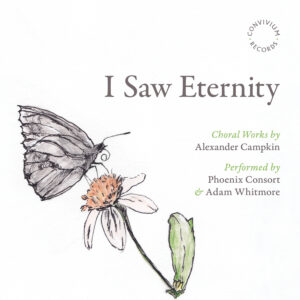
I SAW ETERNITY: CHORAL WORKS BY ALEXANDER CAMPKIN
Phoenix Consort / Adam Whitmore ✦ Convivium CR100
On this debut disc from the recently formed Phoenix Consort, which consists of current and former students of Durham University and is directed by its founder Adam Whitmore, the 19 voices give performances of superb professional quality. The14 pieces that form the collection give an effective overview of the music of Alexander Campkin. Calm me, O Lord is hauntingly beautiful, while the soprano top notes of True Love have an ethereal quality to them, secure in intonation as well as with quality of sound. The harmonic dissonances of I saw Eternity are radiant, while the effective use of dynamics makes this a particularly poignant performance. The quirky effects of Dazzling Darkness, which include whistling and pulsating rhythmic ostinatos, along with atonality, add an extra dimension to it. All works are excellently paced and sung with deep sincerity; it is a recording of exquisite beauty. Highly recommended.
**
REGARDS FROM ROCHESTER: THOMAS HEWITT JONES
BBC Singers / Royal Ballet Sinfonia / Rochester Choral Society / Harriet Mountford (soprano) / Simon Thorpe (baritone) / John Mountford ✦ Vivum Music
Thomas Hewitt Jones’s Regards from Rochester is a substantial 50-minute work for choir and orchestra composed for the 150th anniversary of the Rochester Choral Society. The work is made up of 10 movements that celebrate Rochester’s history, the river Medway, and industrial and literary connections, in addition to its cathedral. The choirs give impassioned performances with clear diction and are ably supported by the Royal Ballet Sinfonia. There’s little for the soloists to do but Harriet Mountford and Simon Thorpe make excellent contributions. The accompanying sleeve notes contain a full libretto, but programme notes and artist biographies are in such small print they are difficult to read. Hewitt Jones is a skilful composer and the work is a fitting tribute to the city of Rochester as well as a memento for Rochester Choral Society on achieving such a significant milestone.
Ian Munro
DVDs
DVD and CD 2-disc pack / filmed by Will Fraser / Daniel Moult (organ) ✦ Fugue State Films FSFDVD017
After an earlier boxed set entitled Bach and Expression, Daniel Moult follows up with the same format consisting of performances (in sound and vision), video lectures and a documentary featuring nine works by J.S. Bach. Except that the authorship of the centrepiece has been questioned, namely the Great Toccata in D minor, or ‘the 565’ as it’s described in the film. Among the contributors we meet Dr Christine Blanken at the Bach Archiv in Leipzig, where Daniel is shown contemporaneous manuscripts of the 565. He argues that, although it might be a youthful work and there’s much that’s atypical of Bach’s style, this doesn’t necessarily mean the composer was someone else. Bach was exploring a wide range of techniques and devices, and was happy to break harmonic rules.
Along with the excellent, engaging performances, there are many fascinating insights here; we are reminded that Bach was alive during a period when improvisation and (as Christine Blanken puts it) ‘having fun’ was the order of the day.
Stuart Robinson

BOOKS
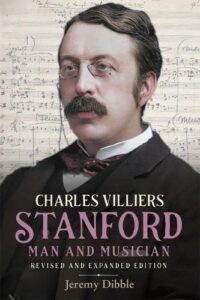
CHARLES VILLIERS STANFORD: MAN AND MUSICIAN
Jeremy Dibble
Revised and expanded edition
Boydell & Brewer 730pp.
HB 978-1-78327-795-7 £70.00
It is hard to believe that over 20 years have elapsed since the publication of Jeremy Dibble’s biography of Charles Villiers Stanford, and it is no surprise in this Stanford anniversary year that a revised and expanded edition is now available. From a different publisher and now in the series ‘Irish Musical Studies’, it has been interesting, as an ardent ‘Stanfordophile’, to compare the two.
Superficially the new edition appears much larger and weighs in at 1.4 kg, but this is deceptive as the two publishers use a different weight of paper. Could it be that the increase of pages from 542 to 715 reflects a different layout and type size rather than extra information? Actually no, the amount of general text per page is identical in the two editions, though the footnotes in this new edition do take up more space. An exception is the list of works, which has almost doubled in size and, sadly, this is not due to any new discoveries of music but instead to a different layout and size of type.
Physical properties aside, what content is new in 2024? The first thing to notice is that the photographs are mainly different and appear less well reproduced on paper that is not glossy. The photograph of the lay clerks at Trinity College in 1875 has been trimmed to exclude individual names but is also marked c.1885 whereas the original photograph quite clearly states 1875. In addition to more numerous musical examples, a new feature is the inclusion of eight music analysis tables relating to both choral and orchestral works. The most expanded sections are ‘The New Generation 1901–1914’ and ‘War and Decline 1914–1924’, with this latter section now including a consideration of Stanford’s late organ sonatas. While it is not feasible to compare every single paragraph, it is clear that Professor Dibble has tweaked many of them with extra information and no doubt 20 years of new sources available has permitted both additions and corrections.
Is it worth upgrading to this edition if you already have the first edition? Probably not, unless special research requirements make it essential. This said, however, no lover of British music should be without this truly outstanding book for, not only does it tell the story of one man and his unique journey, but musical life, musical education and musical controversies within the British Isles, supposedly the ‘land without music,’ are clearly highlighted along the way.
John Henderson
‘WITH ANGELS AND ARCHANGELS’ – SHARING THE WORSHIP OF HEAVEN: BIBLE, POETRY, LITURGY AND DEVOTION IN THE MIDDLE AGES
John Blakesley
Gracewing 188pp.
PB 978-0-85244-719-2 £15.99
Church musicians often come across modern translations of ancient texts without realizing how old are their sources. So, for example, Urbs beata Jerusalem, found as ‘Christ is made the sure foundation’ and as ‘Blessed city, heavenly Salem’, is an office hymn dating back to before the 9th century, while ‘Ye choirs of new Jerusalem’ is translated from St Fulbert who died in 1028. Vexilla regis (‘The royal banners forward go’) and Pange lingua (‘Sing, my tongue, the glorious battle’) were written by Fortunatus in the 6th century.
This fascinating book is primarily a study of the texts of early hymns, tracts (texts inserted mostly into the Kyrie) and sequences (texts added to the singing of the Alleluia before the Gospel). John Blakesley describes their development in the church during the Middle Ages. Non-biblical, unlike, for example, psalms and canticles, Blakesley is keen to emphasize the extent to which the Bible, poetry and worship is interwoven in their verses, not least in an extended discussion of Hildegard of Bingen, paralleling perhaps the way in which allegory is found throughout the Bible. The 10 chapters take us on a wide-ranging tour, geographically as well as over the centuries, and include extended quotations (in English). We end by praising God ‘with angels and archangels and all the company of heavenly’, as earth and heaven come close to each other within high medieval worship.
Julian Elloway

Reviews of printed music
CHORAL MUSIC
E Easy
M Medium
D Difficult
CHRISTMAS
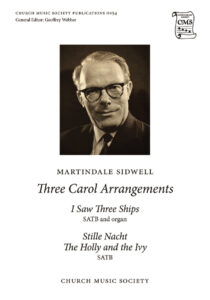
THREE CAROL ARRANGEMENTS [E]
Martindale Sidwell
SATB with divisions (unaccompanied and with organ)
Church Music Society OS54 £3.35
Only the first of these carol arrangements, I saw three ships, requires organ, and that just in the last verse where the organ enters ‘fortissimo, by surprise as it were’ as the editor, Geoffrey Webber, suggests. Stille Nacht appears twice, with German and English text. The holly and the ivy alternates verses with divided SA and TB, plus a repeated SATB chorus. Martindale Sidwell (1916–98) was a distinguished choir director and for eight years a visiting tutor at the RSCM. All three arrangements were recorded by Sidwell and were sung at his Hampstead and St Clement Danes churches. They use the expected tunes and all might be described as urbane and civilized, occasionally witty: it is surprising that they waited until now to be published.
SOMERSET CAROL [E/M]
arr. Roderick Elms
SAB and organ
Camden Music (Universal Edition) CM314 £2.95
THE GREAT CHISHILL MOTETS, VOLUME 2: ADVENT TO CANDLEMAS [E]
Jamie W. Hall
SAB (with or without organ)
Banks Music Publications GCL047 £3.50
Roderick Elms’s arrangement of the Somerset Carol (‘Come all you worthy gentlemen’) is described as being for SATB, but the men only divide into T/B in four bars doubled by organ and in which altos are singing in unison with sopranos; choirs looking for three-part Christmas pieces should certainly consider it. It is a joyful, extrovert setting with some rich harmonies, which choirs of all ages would enjoy singing.
The grandly titled Great Chishill Motets are little anthologies of pieces for three-part choir with single T/B line. Volume 2 includes music for Advent (Advent Responsory and Adam lay y’bounden), Epiphany (Gold, frankincense and myrrh) and Candlemas (O nata lux), along with an English-texted (Book of Common Prayer) Magnificat and Nunc Dimittis. The composer allows for them to be sung unaccompanied or with light organ accompaniment, and has written a lower part suitable for tenors, basses and recently changed voices. A nicely judged 12/8 pastoral touch, echoing a phrase in the Pearsall version of In dulci jubilo, appears in the opening Advent Responsory on the words ‘Hear O thou shepherd of Israel’; it reappears in the Magnificat and the Nunc Dimittis. All the pieces are well shaped, sensitive to the words and with a variety of texture despite their simplicity.
GOD IS WITH US [E]
Timothy Rogers
SATB
Encore Publications 020798 £2.25
SLEEP, MY JESUS, SLEEP [E]
arr. Philip Rushforth
SATB
Encore Publications 020807 £2.75
These two unaccompanied and easy carols, calming and reflective, may help to focus the mind at Christmas. Both describe Jesus as a baby and both look to the future with a message of hope and love. They have the feeling of traditional carols; indeed, Sleep, my Jesus, sleep is arranged from a traditional Ukrainian carol. The flowing melodies and simple, unaffected choral settings contrast with the busyness of many carols. Highly recommended.
THREE CAROLS FOR UPPER VOICES [E]
Edmund Jolliffe
SA and piano
Banks Music Publications GCL048 £2.95
Let the bells ring soft and low takes its cue from its title and, despite forte climaxes, is relaxed and with as much interest in the alto part as in the sopranos. Christ was born today, with words by the composer, mixes secular descriptions of falling snow (in every verse) and speculation about the content of presents, with a conclusion to each verse reminding us to ‘rejoice now for Christ was born today’. Particularly effective is a more contemplative verse reminding us that ‘love is the greatest gift of all’. Sweet was the song is lovely. Imitative verses relax onto gentle settings of ‘lulla, lullaby’, around which the piano provides a garland of quavers.
James L. Montgomery

ORGAN MUSIC
E EASY
M MEDIUM
D DIFFICULT
MANUALS ONLY
TEN VOLUNTARIES FOR MANUALS [M/D]
Greene, Skinner, Stubley, James, Reading, Selby and ‘Kuhnau’
ed. David Patrick
Fitzjohn Music Publications (Banks) FMP230 £12.00
This collection of voluntaries was originally published by C. & S. Thompson c.1767, with Maurice Greene, Simon Stubley and John Reading each represented by two voluntaries, and the others with one each. The name Kuknan, following John Caldwell’s suggestion, is here printed as Johann Kuhnau, an 18th-century German composer, but this has not been universally accepted.
The opening voluntary by Greene is in four movements, including for Cornet (without Echo) and Trumpet (with Echo); the other voluntary by him is a robust Prelude and Fugue. Stubley offers a voluntary with second movement for French Horn alternating with Flute, and another with a second movement for Trumpet and Echo. Reading’s first piece is in two movements, one containing passages on the Choir alternating with Full Organ. The second is a Prelude and Fugue, as is the voluntary by Selby and also the one by ‘Kuknan’. The voluntary by Benjamin Skinner has a solo for Cornet and Echo as its second movement.
There is a brief note on each composer, but there is no commentary on the individual pieces with information on other sources in which the pieces appear and the sometimes significant variants between sources. This notwithstanding, the volume presents a good variety of pieces, the great majority not readily available in modern editions. These voluntaries have much to offer the player for both services and recitals.
John Collins
ANTHOLOGIES
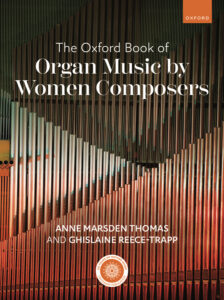
THE OXFORD BOOK OF ORGAN MUSIC BY WOMEN COMPOSERS [E–D]
compiled and edited by Anne Marsden Thomas and Ghislaine Reece-Trapp
Oxford 978-0-19-356272-1 £26.95
The editors describe their challenges in compiling this volume of organ music by female composers, including its infrequent and sometimes pseudonymous publication, the identification of the organ as a ‘male’ instrument unlike other keyboard or plucked instruments, and the restriction on the style of music that society expected from women. Nevertheless, here are 42 pieces that are all indisputably worthy of publication and performance, even if a few are transcriptions from piano or other instruments.
There are commissions from Kristina Arakelyan, Miriam Carpinetti, Ghislaine Reece-Trapp, Isabelle Ryder, Amy Summers and Rebecca Groom te Velde. The remaining 36 pieces range over five centuries, with the earliest from Clementine de Bourges (c.1530–61). Unsurprisingly, a majority are from the 19th and 20th centuries, among the better-known names being Louise Farrenc (1804–75), Clara Schumann (1819–96), Ethel Smyth (1858–1944), Amy Beach (1867–1944), Florence Price (1887–1953), Nadia Boulanger (1887–1979) and Jeanne Demessieux (1921–68). Among living composers, as well as the six commissions, particular mention should be made of Cecilia McDowall FRSCM, who is represented by a shortened version of her Celebration, commissioned by the University of Portsmouth when awarding her an honorary doctorate.
There is a wide range of styles, sacred and secular, providing music for recital and church service, and for teaching, thanks to a second contents list in graded order, showing duration and grade of difficulty (the majority are Grades 5–8). Ten pages of notes provide information about each of the 42 composers and the music. Large format, clearly printed and sturdily bound, this volume should provide a much-appreciated resource for organists.
See also Born in a Stable, reviewed below under Advent and Christmas.
BREVISSIMA! SHORT VERSIONS OF ROMANTIC ORGAN PIECES [D]
Arr. Werner Freiberger
Butz-Verlag BU3088 €16.00
How often after a wedding are you only a quarter of the way through the Widor ‘Toccata’, or whatever, and all the congregation have left? Do you continue playing to an empty church, or do you turn over several pages and skip to the coda? If tempted to do the latter, these abbreviated versions of 12 toccatas, sorties and similar pieces make the shortening seamless. Each fits into five pages, apart from the Widor itself (four pages) and the Guilmant ‘Final’ from his Première Sonate (six pages). Other toccatas found here are by Dubois, Boëllmann, Gigout, Renaud, Fletcher and Nevin. Lemmens has two pieces, the stand-alone Fanfare and the ‘Marche Pontificale’ from his Sonate No. 1. Lefébure-Wely (the E flat major Sortie) and Vierne complete the roll call. For the most part, the original pieces have a quieter central section that is replaced here by such transition as is required and the festive nature of the original start and finish is maintained. The music is not simplified in any way, which leads me to wonder whether most organists capable of playing it are not also capable of making the abbreviations themselves. On the other hand, the arranger suggests that the volume might encourage organists unfamiliar with some of the pieces to go on to learn their original versions.

18 EINZELWERKE FÜR ORGEL / 18 PIECES FOR ORGAN [E–M/D]
Alexandre Guilmant
ed. Kurt Lueders
Butz-Verlag BU3078 €22.00
This is a wide-ranging selection of short and medium length pieces by Alexandre Guilmant (1837–1911) that are not easily available for performers. The range includes pieces from early in Guilmant’s life – the 1861 Offertoire (Introduction and Fugato) and Prélude (in F) – and the Trois Oraisons of 1910, his last published work. They range from easy two-stave pieces to pieces for more advanced players, although none are really difficult. Four of the stand-alone pieces are based on plainsong themes and there is also a set of vesper versets, a sort of liturgical suite. Of the 13 free compositions, one that deserves to become a popular recital item is the most difficult piece in the anthology, a delightful and catchy Fughetta de Concert that Guilmant had written for harmonium 40 years before he made this organ arrangement. The editor has provided an excellent general introduction and detailed notes about each piece, all in three languages.
Duncan Watkins

ADVENT AND CHRISTMAS
BORN IN A STABLE: ORGAN MUSIC FOR ADVENT AND CHRISTMAS [E/M–D]
compiled by Timothy Rogers
Encore Publications 010043 £18.95
Of the 15 composers included in this anthology, all are living and nine are women. Edmund Connolly starts the volume with vividly characterized Eight O antiphon preludes, from the mighty wisdom of ‘O Sapientia’ and flame of fire of ‘O Adonai’ through to the sparking, inexplicable mystery of ‘O Virgo virginum’. Most of the other pieces are based on familiar carol or hymn tunes, including Sarah MacDonald’s Toccata on ‘Veni Emmanuel’, announced by the ‘Rejoice, rejoice’ rhythm, William Campbell’s 136-bar crescendo from triple piano to quadruple forte in a Flourish on ‘Irby’ and Joy Williams’s The merry organ, combining ‘The holly and the ivy’ and ‘We wish you a merry Christmas’.
Neil Cox’s Carillon on ‘Divinum mysterium’ imaginatively surrounds the melody with bright bell-like sounds. Gentler pieces include Sasha Johnson Manning’s Berceuse on ‘Quelle est cette odeur agréable?’, Miriam Reveley’s Prelude on ‘Stille Nacht’, Esther Bersweden’s Interlude on ‘Away in a manger’ and an atmospheric Canon on ‘Humility’ by John Scott Whiteley, in which the tune appears as a 4ft canon in the pedals with a halo of chords on 8ft Celestes. Among other unexpected delights is Tom Winpenny’s transcription of Bryan Kelly’s orchestral A Christmas Dance. The dance is a joyful treatment of Sir Roger de Coverley, in which ‘The first nowell’ makes an appearance. Pieces by Janet Wheeler, Alison Willis, Gail Randall, Amy Summers and Jack Wilson complete this wide-ranging volume. It does not duplicate other collections of Christmas organ music: players will find it a useful addition to their Advent and Christmas music.
FESTIVAL TOCCATA ON ‘IN DULCI JUBILO’ [D]
Samuel Kemp
Banks Music Publications 14134 £4.95
TOCCATA ON ‘WACHET AUF’ [M/D]
David Halls
Banks Music Publications 14133 £4.95
A competition to mark the restoration of the York Minster organ in 2021 included an 18-and-under category, in which Samuel Kemp’s ‘In dulci jubilo’ toccata won first prize and it was first performed at the end of the Minster’s Nine Lessons and Carols that year. It follows an expected toccata layout with pedal tune and manual semiquavers, but includes rhythmic and harmonic surprises as well as a quieter middle section. Played by an accomplished player (Benjamin Morris at the premiere) with a wide right-hand span, plus a large instrument, it would sound exciting.
Less difficult, but perhaps with more impact, is the winning entry for the adult category: a highly professional and polished ‘Wachet auf’ toccata by David Halls. There is more variety and unpredictability in treatment as short but instantly recognizable fragments of the melody appear in manuals and pedals amid semiquaver patterns derived from the chorale. It builds to a richly harmonized statement of the final phrase of the chorale. A flourish of a coda culminates with the pedals cheekily suggesting fragments of J.S. Bach’s Wachet auf countermelody.
CHRISTMAS PRELUDES AND FANTASIA [M]
Alan Bullard
Banks Music Publications 14135 £8.95
Of these six organ pieces for Christmas, the ones that appeal most to me have an outdoor, pastoral feel. Whence is that goodly fragrance? is decorated by what might be a shepherd’s pipe playing at first above a pedal drone. He is born! also has harmonic drones and a rustic feel. The Angel Gabriel features nice rhythmic syncopations at the ends of phrases and builds to a forceful climax. Infant holy is distinguished by a radiant climax and has a subtlety that contrasts with the more four-square As with gladness men of old. After the five separate preludes comes the Christmas Fantasia, a short sequence of well-known carol tunes that one can imagine played before or after a Christmas morning service.

ORGAN MUSIC FOR THE CHRISTMAS SEASON [E/M]
Tim Knight Music TKM877 £11.95
These six pieces were entries for a Christmas organ music competition sponsored by the publisher – the result is a mixture of styles, of invention and indeed of competence. One can easily collect anthologies of arrangements of Christmas tunes, and any new anthology needs to contain ‘must-have’ pieces. Alison Willis provides one such with her Yea, Lord, we greet thee, which, in less than two minutes, provides an effective introduction to (or recessional from) Adeste fideles and references the ‘Ding dong, merrily’ motive from Sir David Willcocks’s descant. Boston-based Jim Dalton contributes an atmospheric Prelude: The truth from above that allows the English traditional tune to appear in canon and inversion. Pedal points and a homophonic treatment with three-part superimposed fourths in a sort of parallel organum add a medieval feel to what is stylistically the most contemporary of the pieces. South African Theo van Wyk’s Prelude on ‘In dulci jubilo’ needs careful registration of 8ft tune and 4ft accompaniment to make its artfully simple effect. Colin Ashworth contributes the winning piece (Joyful angels, based on Iris with an interjection from ‘Ding dong, merrily’); Anthony Giamanco (Masters in this hall) and Adam Heron (Prelude on ‘Cranham’) complete the anthology.
Julian Elloway
HOWARD SKEMPTON
50 PRELUDES AND FUGUES, BOOK 1 and BOOK 2 [E/M]
Howard Skempton
Oxford 978-0-19-357295-9 and 978-0-19-357297-3 £17.95 each
Howard Skempton is one of Britain’s most respected and distinguished composers: his early influences include Cardew, Cage and Feldman, yet over the decades his compositional voice has defied categorizing and remains strongly and uniquely his own.
These two volumes of Preludes and Fugues were commissioned, first performed and subsequently recorded by Matthew Owens on the Fowkes organ of St George, Hanover Square (Book 1) and the Dobson organ of Merton College, Oxford (Book 2). They continue the explorations of his 24 Preludes and Fugues for piano (2019) and contain many of Skempton’s long-standing textures and themes: static, chordal writing; canon and imitation; folk-like melody; patterns and inversions. This is music stripped of all its adjectives and adverbs: pure sound, structure laid bare, yet worthy of repeated study. Some movements are relatively extended, some are fleeting, but none lasts more than two or three minutes and all are uniquely fascinating.
The technical challenges are slight, at least on the surface, but careful thought needs to be given to clarity of registration and appropriate tempi. This is essential, beautiful music, appropriate for any setting but none more so than simply playing for one’s own heart and mind.
Huw Morgan